Replacing a furnace air filter is a straightforward home maintenance task that takes fewer than 10 minutes, requires no special tools, and can be completed safely by any homeowner without professional help. The process involves turning off your HVAC system, locating the filter compartment, sliding out the old filter, and inserting a correctly sized replacement with the airflow arrow pointing toward the furnace. Done correctly, this simple routine protects your heating system from damage and keeps the air inside your home measurably cleaner.
Before you begin, you need three things to replace a furnace air filter successfully: the correct replacement filter in the right size and MERV rating for your system, a basic understanding of where your filter compartment is located, and a trash bag to dispose of the dirty filter without spreading dust. Skipping the preparation step is the most common reason homeowners install the wrong filter or reinstall it in the wrong direction, both of which reduce system efficiency immediately.
How often you should replace a furnace air filter depends on filter thickness and your household conditions. Standard 1-inch filters need replacement every one to three months, while thicker 4-to-5-inch filters can last six to twelve months. Homes with pets, young children, or residents with allergies or asthma should shorten that interval significantly. Understanding your replacement schedule is just as important as knowing the installation steps, because even a correctly installed filter becomes a liability when left in place too long.
To help you handle every aspect of this task with confidence, this guide covers what a furnace air filter actually does, exactly what you need to buy and prepare, a complete step-by-step replacement walkthrough, and a clear schedule for ongoing maintenance.
What Is a Furnace Air Filter and What Does It Do in Your Home?
A furnace air filter is a replaceable mechanical barrier installed inside your HVAC system that captures airborne particles, including dust, pollen, pet dander, mold spores, and bacteria, before they circulate through your home or accumulate inside the furnace itself. It sits at the point where return air enters the air handler or blower compartment, acting as the first and only line of defense between your living environment and the internal components of your heating system.
Understanding what a furnace filter actually does helps clarify why replacing it on schedule matters so much. Specifically, the filter performs two simultaneous jobs that benefit both your health and your equipment.
Job 1: Protecting indoor air quality. As your HVAC system runs, it pulls air from every room through return air ducts and pushes it back out through supply vents. Without a filter, every cycle recirculates the same dust, allergens, and particulates. The filter intercepts those particles on each pass, progressively reducing the concentration of contaminants in your indoor air. The efficiency of this process is measured by the MERV rating, which stands for Minimum Efficiency Reporting Value. A filter rated MERV 1 to 4 catches only large particles like lint and dust bunnies. A filter rated MERV 8 to 11 captures finer particles including mold spores and pet dander. A filter rated MERV 13 and above removes bacteria and smoke particles. The higher the MERV rating, the finer the filtration, but also the greater the airflow resistance.
Job 2: Protecting the furnace itself. Dust and debris that bypass a missing or clogged filter coat the blower motor, heat exchanger, and evaporator coil. This layer of buildup forces the system to work harder to move the same volume of air, raising energy consumption and accelerating mechanical wear. According to the U.S. Department of Energy, a dirty or clogged air filter can increase your HVAC system’s energy consumption by 5 to 15 percent compared to a clean filter under identical conditions.
Airflow direction is a critical attribute that connects filter function to installation accuracy. Every filter is designed so that air flows through it in one specific direction, from the pleated media side toward the wire mesh or cardboard frame backing. An arrow printed on the filter frame indicates this direction. Installing a filter backward partially defeats its filtration purpose and can cause premature collapse of the filter media into the blower.
What Do You Need to Replace a Furnace Air Filter?
To replace a furnace air filter, you need the correct replacement filter in the matching size and appropriate MERV rating, a trash bag for the old filter, and optionally a flashlight and a marker to note the installation date on the new filter frame. No power tools, screwdrivers, or technical skills are required for most residential HVAC systems.
Dưới đây is a closer look at each preparation item and how to get it right before you start:
Replacement filter: This is the only item you must purchase. Getting the size and type wrong means a wasted trip to the store and a furnace left running unprotected. See the H3 sections below for a complete guide to finding your correct size and choosing the right filter type.
Trash bag: Slide the old filter directly into a bag immediately after removal. A visibly dirty filter can hold a significant amount of accumulated dust and particulates. Handling it without containment spreads that material back into the air you just paid to heat.
Flashlight: Many filter compartments are located in utility rooms, basements, or closet-mounted air handlers where overhead lighting is poor. A flashlight helps you read the airflow arrow on the new filter and confirm the old filter slides out cleanly.
Permanent marker: Write the installation date on the side of the new filter frame before you slide it in. This simple step eliminates guesswork at your next maintenance check and takes three seconds.
How Do You Find the Right Size Furnace Air Filter for Your System?
The correct size for your replacement furnace air filter is printed directly on the cardboard frame of your existing filter, typically formatted as three numbers representing length, width, and thickness in inches, for example 16x25x1 or 20x25x4. That printed size is the nominal size and is what you enter when shopping for a replacement.
Cụ thể, here is exactly how to locate and use that information:
Step 1: Check the existing filter frame. Pull out your current filter and look at the cardboard or metal border around the edges. The size is usually printed in bold on one of the flat sides, often alongside the brand name and MERV rating.
Step 2: Measure manually if the label is missing or illegible. Use a tape measure to measure the length and width of the filter to the nearest inch, then measure the thickness. Round each measurement to the nearest whole inch to get the nominal size. Note that nominal size and actual size are not identical. A filter labeled 16x25x1 typically measures approximately 15.75 x 24.75 x 0.75 inches in actual dimensions. Always shop by nominal size, not measured actual size, because replacement filters are labeled using nominal sizing conventions.
Step 3: Check your furnace manual or the door panel of the air handler. Many manufacturers print the required filter size directly on the inside of the filter access panel or in the system documentation.
Step 4: Look up your furnace model number online. If none of the above methods yield a clear answer, entering your furnace model number into the manufacturer’s website will return the specified filter dimensions.
Buying a filter even a fraction of an inch too small in any dimension allows unfiltered air to bypass the filter around its edges, defeating the entire purpose of the replacement.
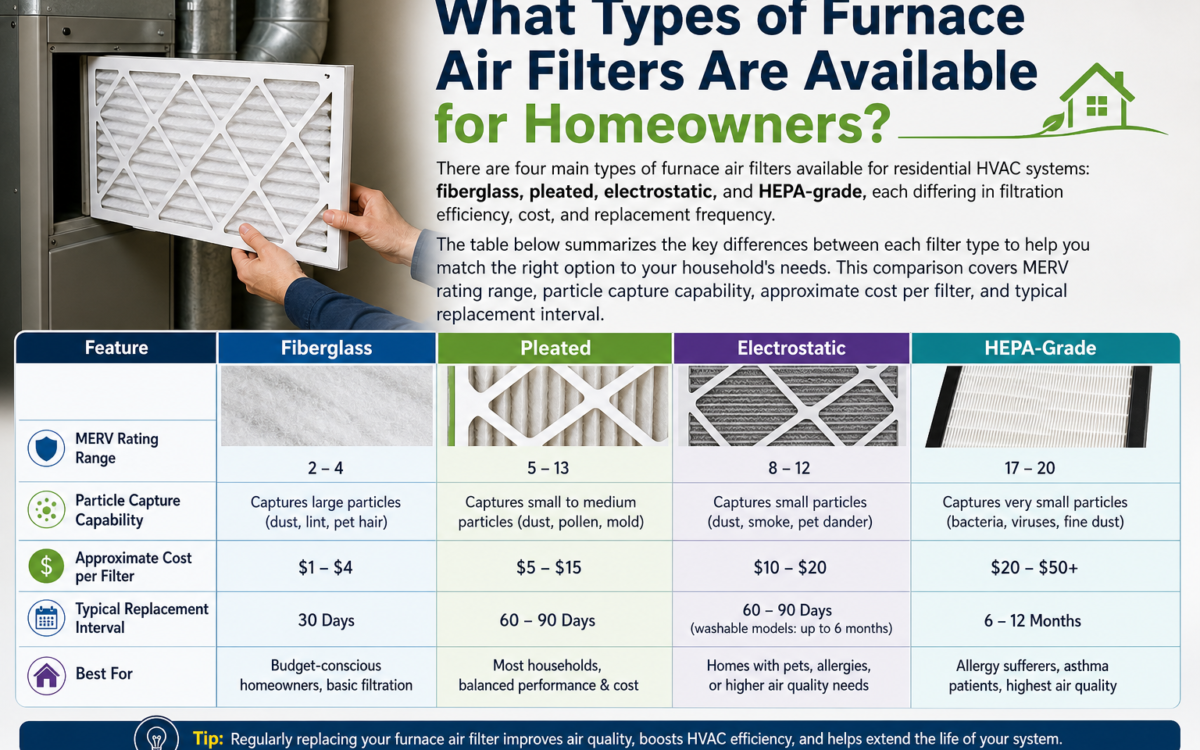
What Types of Furnace Air Filters Are Available for Homeowners?
There are four main types of furnace air filters available for residential HVAC systems: fiberglass, pleated, electrostatic, and HEPA-grade, each differing in filtration efficiency, cost, and replacement frequency.
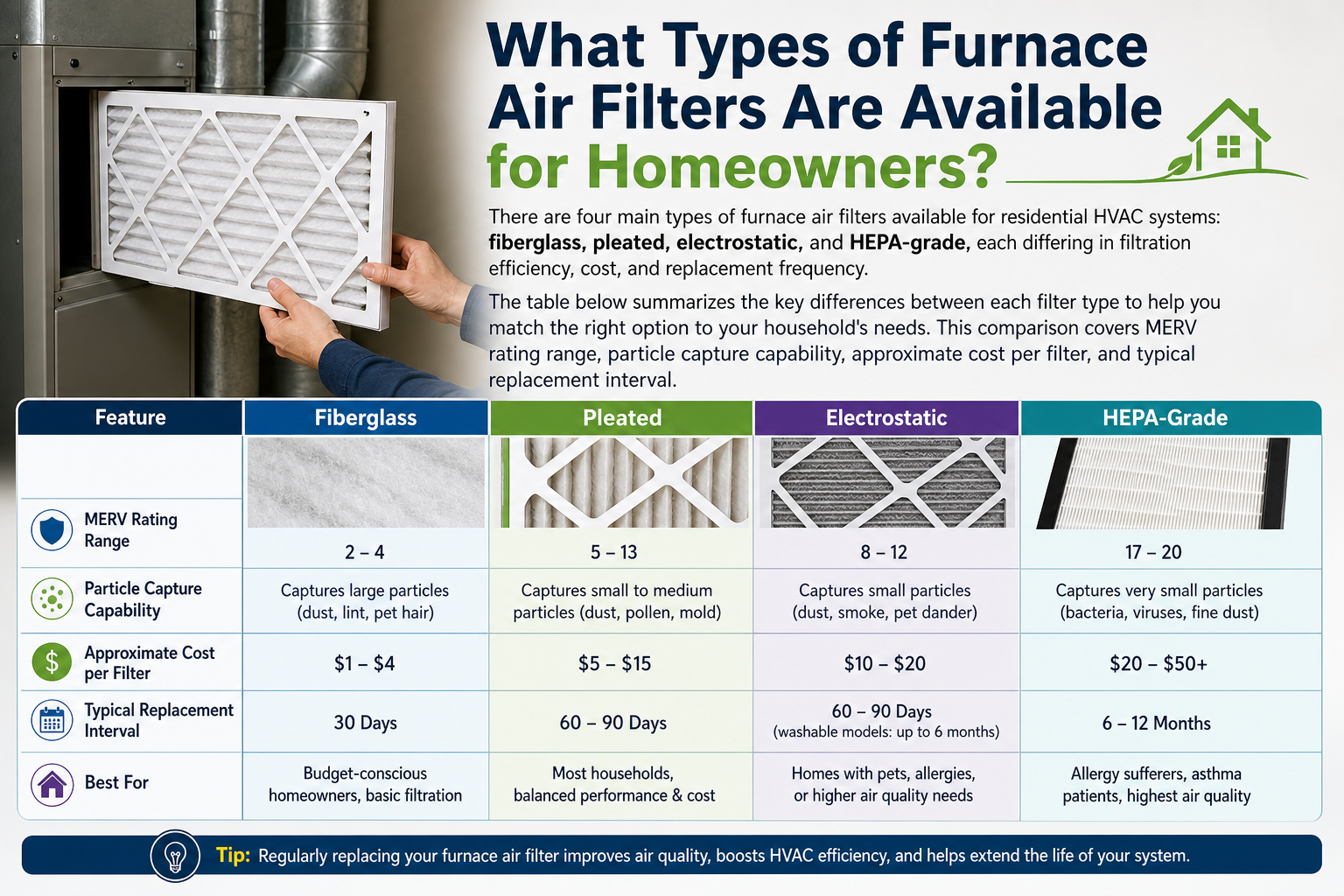
The table below summarizes the key differences between each filter type to help you match the right option to your household’s needs. This comparison covers MERV rating range, particle capture capability, approximate cost per filter, and typical replacement interval.
| Filter Type | MERV Rating | Best For | Cost Per Filter | Replacement Interval |
|---|---|---|---|---|
| Fiberglass | 1 to 4 | Basic dust protection, older systems | $1 to $4 | Every 30 days |
| Pleated (standard) | 5 to 8 | General household use | $5 to $15 | Every 60 to 90 days |
| Pleated (high-efficiency) | 11 to 13 | Allergy sufferers, pet owners | $15 to $30 | Every 60 to 90 days |
| Electrostatic | 8 to 10 | Reusable option, eco-conscious homes | $20 to $40 upfront | Wash monthly |
| HEPA-grade/Media | 13 to 16 | Asthma, severe allergies | $30 to $60 | Every 6 to 12 months |
Fiberglass filters are the thinnest and least expensive option. They protect the furnace from large debris but do very little to improve air quality. They are appropriate for systems that cannot handle the airflow resistance of denser filters.
Pleated filters are the most widely recommended choice for typical households. The folded design increases surface area, allowing more particles to be captured without proportionally increasing airflow restriction. A MERV 8 pleated filter represents the best balance of filtration performance and system compatibility for most residential furnaces.
Electrostatic filters use synthetic fibers that generate a static charge as air passes through, attracting particles like a magnet. The washable versions eliminate recurring purchase costs but require monthly cleaning to maintain effectiveness.
HEPA-grade filters offer the highest particle capture rate but also the highest airflow resistance. Before installing a MERV 13 or higher filter, confirm that your furnace’s blower motor is rated to operate against that level of static pressure. Installing a filter with too high a MERV rating on an incompatible system forces the blower to strain, shortening motor life and reducing airflow to a level that causes the heat exchanger to overheat.
How Do You Replace a Furnace Air Filter Step by Step?
Replacing a furnace air filter involves seven sequential steps: turning off the system, locating the filter compartment, removing the old filter, inspecting it, reading the airflow arrow on the new filter, installing the new filter in the correct orientation, and restarting the system. The entire process takes five to ten minutes for most homeowners.
Dưới đây is the complete walkthrough, divided into two logical phases: removing the old filter and installing the new one.
How Do You Locate, Access, and Remove the Old Furnace Air Filter?
Locating and removing the old furnace air filter requires four steps: shutting off the HVAC system at the thermostat, finding the filter compartment on the air handler or return air duct, opening the access panel, and sliding the dirty filter out carefully without shaking it.
Cụ thể, follow these steps in order:
Step 1: Turn off your furnace or HVAC system. Go to your thermostat and set the system to “Off.” Do not simply set it to a temperature that won’t trigger the furnace; switch the system mode completely off. This stops the blower from running while you have the filter compartment open, which prevents unfiltered air from being pulled through during the changeover and stops dust from scattering.
Step 2: Locate the filter compartment. The filter in most homes sits in one of three places:
- Inside the air handler or furnace cabinet, accessed by a removable panel on the side or bottom of the unit.
- At the return air duct, which is a large vent (usually 14×24 inches or larger) mounted on a wall, floor, or ceiling and covered by a grille.
- Inside a dedicated filter cabinet between the return duct and the air handler, common in systems with thick 4-to-5-inch media filters.
If you are unsure which location applies to your system, check the furnace owner’s manual or look for the largest vent in your home, typically in a hallway, utility room, or basement.
Step 3: Open the access panel. Most residential filter compartments use a sliding panel, a hinged door, or a simple friction-fit grille that requires no tools to open. Some older systems use screws. If your system uses screws, keep a flathead or Phillips screwdriver nearby for this step.
Step 4: Slide the old filter out and examine it. Pull the filter out slowly and hold it over a trash bag immediately. A filter that is dark gray or black is overdue for replacement. A filter that is lightly gray with uniform dust coverage is at the end of its normal service life. A filter with visible black streaks, mold spots, or structural damage (collapsed pleats, torn media) indicates a problem that may warrant a call to an HVAC technician to inspect the system beyond just the filter.
Important precaution: Keep the dirty face of the filter pointing upward or slide it directly into a trash bag in one smooth motion. Shaking or tilting the filter releases accumulated particles back into the air or onto surfaces around the furnace.
How Do You Insert and Secure the New Furnace Air Filter Correctly?
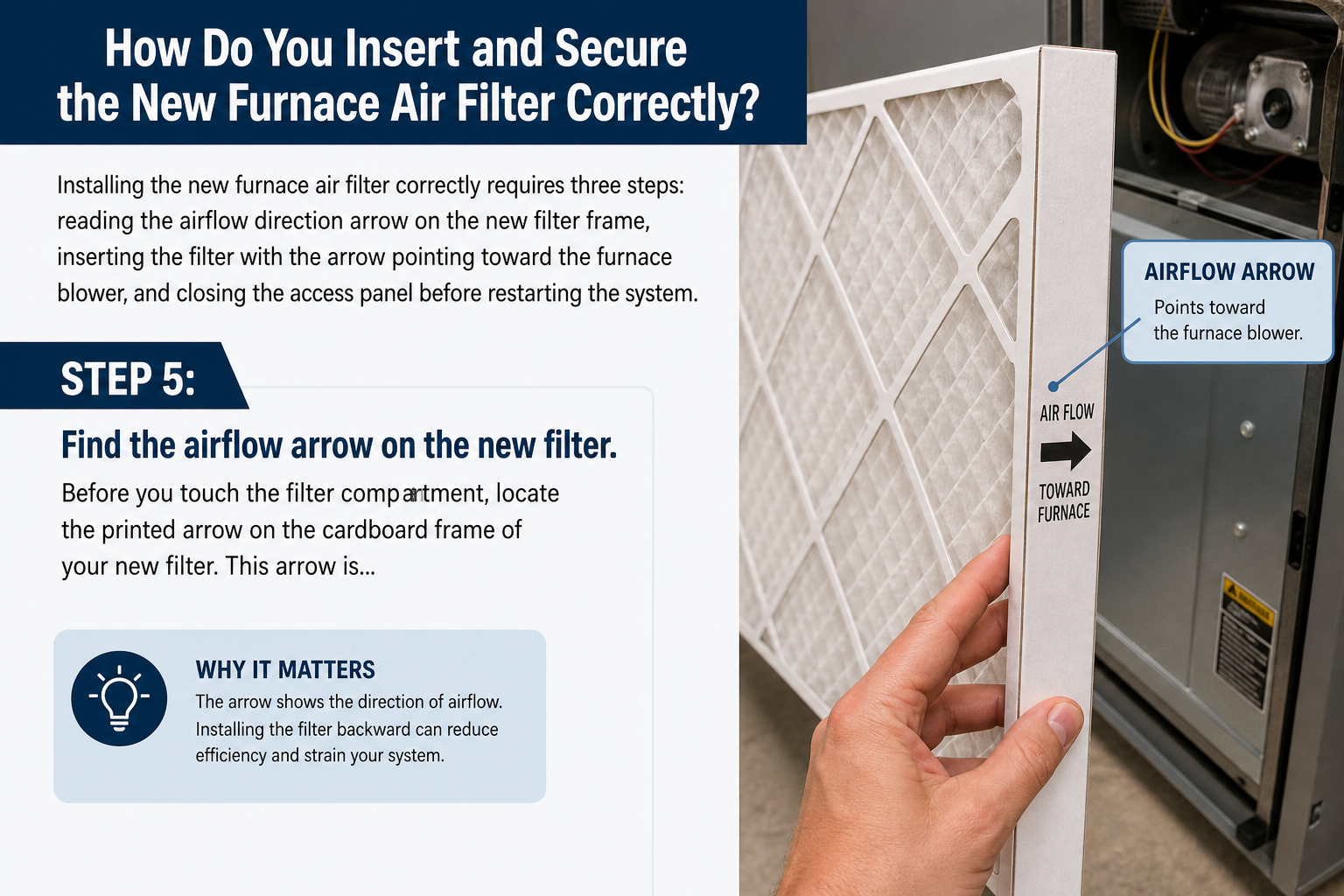
Installing the new furnace air filter correctly requires three steps: reading the airflow direction arrow on the new filter frame, inserting the filter with the arrow pointing toward the furnace blower, and closing the access panel before restarting the system.
Cụ thể, here is how to complete the installation without error:
Step 5: Find the airflow arrow on the new filter. Before you touch the filter compartment, locate the printed arrow on the cardboard frame of your new filter. This arrow is not decorative; it indicates the direction air must flow through the filter media to function correctly. The arrow must point away from the return air duct and toward the furnace blower or air handler.
Step 6: Slide the new filter into the compartment in the correct orientation. Position the filter so the arrow faces the furnace side of the compartment and slide it fully into the slot until all four edges sit flush against the compartment walls. There should be no visible gap between the filter frame and the surrounding housing. If the filter slides in loosely with gaps on any side, you have the wrong size. A filter that does not fit flush allows unfiltered air to bypass it entirely.
Step 7: Close the access panel, write the date on the filter frame, and restart the system. Secure the panel fully. Set your thermostat back to your desired temperature and operating mode. Listen for the blower to start normally. A correctly installed filter produces no change in sound compared to your system’s usual operation. If you hear a rattling or whistling noise, the filter is likely vibrating due to a poor fit or incorrect sizing and should be rechecked.
The most common installation error is reversing the filter direction. A backward filter forces air through the filter media in the direction opposite to its engineered design. Pleated filters in particular can collapse forward into the blower compartment when air pressure hits the wrong face, creating a blockage that can cause the furnace to overheat and trigger a safety shutoff.
How Often Should You Replace a Furnace Air Filter?
How often you should replace a furnace air filter depends on filter thickness and your household conditions, ranging from every 30 days for basic 1-inch fiberglass filters in busy homes to every 12 months for thick media filters in smaller, pet-free households.
The table below provides a complete replacement schedule organized by filter type and household situation, so you can identify the interval that applies directly to your home.
| Household Situation | 1-Inch Filter | 4-to-5-Inch Filter |
|---|---|---|
| Single adult, no pets, no allergies | Every 60 to 90 days | Every 9 to 12 months |
| Average family (2 to 4 people, no pets) | Every 60 days | Every 6 to 9 months |
| Home with one pet (dog or cat) | Every 30 to 45 days | Every 6 months |
| Home with multiple pets | Every 20 to 30 days | Every 3 to 6 months |
| Resident with allergies or asthma | Every 30 to 45 days | Every 3 to 6 months |
| Vacation home (rarely occupied) | Every 6 to 12 months | Every 12 months |
Bên cạnh đó, replacement schedules are general guidelines, not guarantees. Certain conditions accelerate filter loading regardless of the standard interval. Replace your filter sooner than scheduled if you notice any of the following warning signs:
- Visible darkening: Hold the filter up to a light source. If you cannot see light through the media, airflow is already compromised.
- Dusty smell from vents: When a filter is overloaded, particulates begin to pass through or around it, producing a noticeable musty or dusty odor from supply vents.
- Unusual increase in energy bills: A clogged filter forces the blower motor to work significantly harder. An unexplained spike in heating costs during periods of consistent use often traces back to a saturated filter.
- Furnace running continuously without reaching the set temperature: Restricted airflow reduces the system’s ability to transfer heat effectively, causing it to run longer cycles to meet the thermostat setpoint.
- More dust accumulating on furniture than usual: When the filter can no longer capture incoming particles, more of them complete the full circulation loop and settle on surfaces throughout the home.
According to the Air Filter Manufacturers Association, replacing a standard 1-inch filter every 90 days is the baseline minimum recommendation for average households, but this interval assumes a home with no pets, no allergy sufferers, and typical dust levels, conditions that represent a minority of actual households.
Can You Replace a Furnace Air Filter Yourself Without Calling a Professional?
Yes, the vast majority of homeowners can replace a furnace air filter themselves without calling a professional. Filter replacement is the single most basic HVAC maintenance task, requires no tools in most cases, poses no safety risks when the system is turned off beforehand, and is explicitly designed to be performed by homeowners between professional service visits.
Cụ thể, here is why this task falls well within the capability of any non-technical homeowner:
- The filter slot is accessible by design, requiring only the removal of a panel or grille with no disassembly of mechanical components.
- No electrical, gas, or refrigerant systems are touched or disturbed during the process.
- Filter manufacturers print installation direction directly on the product frame to eliminate guesswork.
- The only consumable you need to purchase is available at any hardware store, home improvement retailer, or online.
- The entire task, including preparation and cleanup, takes under ten minutes once you know where your filter compartment is located.
Tuy nhiên, there are specific situations in which calling an HVAC professional is the correct decision rather than attempting to handle the filter yourself:
Zoned HVAC systems: Homes with multiple zones and multiple air handlers may have filter compartments in non-obvious or difficult-to-access locations. If you are not certain how many filter points your system has, a technician can map them during a service visit.
Filter compartment damage: If the filter access panel is corroded, warped, or broken, or if the filter slides in the slot feel sticky or deformed, forcing the panel risks damaging the housing. A technician can assess whether the compartment needs repair before a new filter is installed.
Filter that cannot be removed: If a filter is stuck due to moisture, mold growth, or a damaged frame that has expanded, do not force it. Tearing the filter media inside the compartment can release a concentrated burst of trapped particulates directly into the system.
Unknown system configuration: Very old furnaces, oil-fired boilers with air handling attachments, or custom-built HVAC systems may have non-standard filter locations or require specific filter types that are not obviously labeled on the system. A one-time consultation with a technician to identify the filter type and location is worthwhile in these cases.
For the overwhelming majority of homes built in the past three decades with standard forced-air furnace systems, filter replacement is a homeowner task that requires no professional involvement whatsoever.
What Is the Difference Between Reusable and Disposable Furnace Air Filters?
Reusable filters have a higher upfront cost but can be washed and reinstalled repeatedly, while disposable filters are replaced entirely on each cycle. Reusable filters win on long-term cost and environmental impact, while disposable filters win on convenience and peak filtration consistency after each replacement.
Hơn nữa, the choice between these two filter categories involves trade-offs across several practical dimensions that affect your maintenance routine.
Cost comparison: A washable electrostatic filter costs between $20 and $40 at initial purchase but can last three to five years with monthly cleaning. A comparable disposable pleated filter costs $8 to $15 per unit and needs replacement every one to three months. Over a five-year period, a reusable filter may cost $40 total versus $200 to $600 in disposable filters depending on your replacement frequency.
Filtration consistency: Disposable pleated filters deliver their rated MERV efficiency from day one through the end of their service life. Washable filters can lose static charge and structural integrity over repeated wash cycles, gradually reducing their effective MERV rating. If maximum filtration consistency is the priority, disposable high-efficiency pleated filters hold a performance edge.
Environmental impact: Disposable filters generate solid waste with every replacement cycle. A household replacing a 1-inch filter every 60 days discards six filters per year. Over ten years, that is sixty filters entering the landfill. Reusable filters significantly reduce this waste stream.
Maintenance requirement: Disposable filters require only a purchase and a swap. Washable filters require monthly removal, rinsing under running water, full drying before reinstallation (to prevent mold growth inside the filter compartment), and reinstallation. If the filter is reinstalled while still damp, mold can develop on the media and spread through the duct system.
What Are the Best Furnace Air Filters for Homeowners with Allergies, Asthma, or Pets?
The best furnace air filters for homeowners with allergies, asthma, or pets are pleated filters rated MERV 11 to 13, which capture the fine particles and biological contaminants that trigger respiratory symptoms, including pet dander, mold spores, dust mite debris, and fine pollen.
Cụ thể, here are the recommendations by household situation:
Pet owners: A MERV 11 pleated filter changed every 30 to 45 days captures pet dander effectively without over-restricting airflow in most standard furnaces.
Allergy sufferers: A MERV 13 filter removes particles as small as 0.3 microns, which includes the majority of known respiratory allergens. Confirm your furnace blower is compatible with MERV 13 before installing, as older or lower-capacity systems may experience airflow issues.
Asthma sufferers: MERV 13 or above, combined with a sealed filter compartment to eliminate bypass gaps, provides the most meaningful reduction in airborne triggers. According to the American Lung Association, maintaining indoor air quality through regular high-efficiency filter replacement is one of the most cost-effective steps asthma households can take to reduce symptom frequency.
Important note: Installing a MERV rating higher than your furnace manufacturer specifies can restrict airflow enough to cause the heat exchanger to overheat, triggering the high-limit safety switch repeatedly. Always check your owner’s manual for the maximum recommended MERV rating before upgrading filter efficiency.
Is It Worth Paying More for a High-MERV Furnace Air Filter vs. a Standard Filter?
A high-MERV filter is worth the additional cost for households with allergy sufferers, asthma patients, pets, or anyone who prioritizes measurably cleaner indoor air. For healthy households with no pets and low dust sensitivity, a standard MERV 8 pleated filter delivers adequate performance at lower cost.
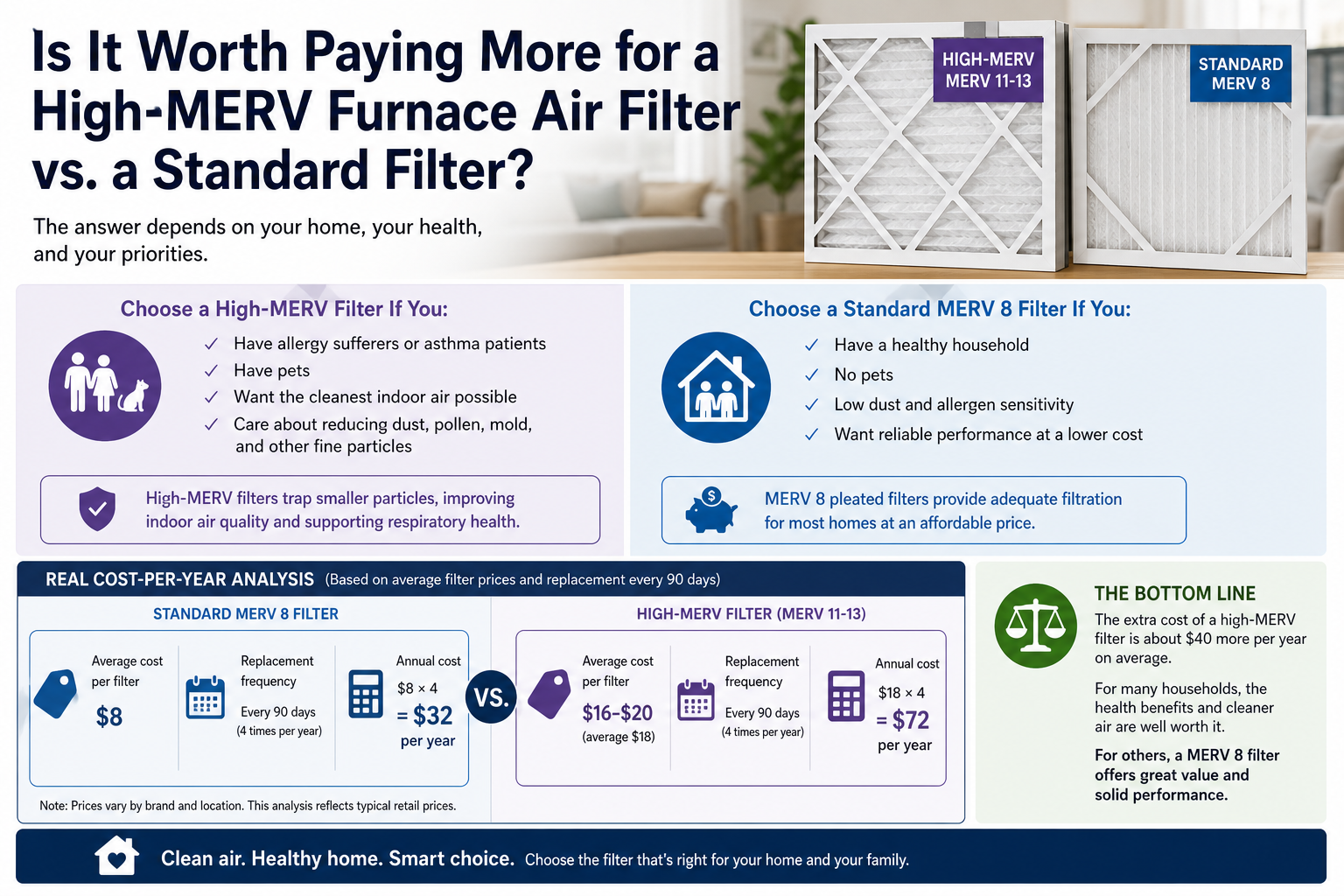
Cụ thể, here is a real cost-per-year analysis to put the price difference in context:
Standard MERV 8 filter: Average cost of $8 per filter, replaced every 90 days. Annual cost: approximately $32 for four filters per year.
High-efficiency MERV 13 filter: Average cost of $25 per filter, replaced every 90 days due to faster loading in typical households. Annual cost: approximately $100 for four filters per year.
The additional $68 per year buys meaningfully better capture of fine particles, bacteria, and smoke. For households where a member manages chronic asthma or severe seasonal allergies, reduced symptom frequency and fewer medical visits can represent savings that far exceed the filter cost difference.
Hơn nữa, high-MERV filters combined with a smart thermostat that tracks runtime hours can optimize the replacement schedule precisely. Several smart thermostat platforms, including Google Nest and Ecobee, send filter replacement reminders based on actual system runtime rather than calendar days, which accounts for seasonal usage variation. This feature is particularly useful when using premium filters where over-extending the replacement interval wastes the quality you paid for, and replacing too early wastes money.
Tóm lại, the filter type that is worth paying more for depends entirely on your household profile. High-MERV filters deliver clear, documentable benefits for sensitive households. For average healthy households, a consistently replaced MERV 8 filter is the smarter financial choice.